
One stat. One click. One brand I'll never trust again.
Fake Facts: How evidence gets distorted and misrepresented across the internet
Humans are as much to blame as AI for spreading fake facts in thought leadership.
I was doing some background research recently, when a powerful fact caught my eye. It was the killer stat I’d been looking for: $184bn is the cost of supply chain disruption. Perfect to help anchor my client’s thought leadership on the impact of conflict around the Strait of Hormuz.
Next, I did what I always do, and started to trace the “fact” back to a reliable source. It didn’t take long for my killer stat to start looking questionable, as I realised that the actual figure had been drastically misreported.
It was another close call. If I hadn’t checked, if I’d included it in our report, my client could have looked sloppy, or even dishonest.
Relieved as I was to catch the falsehood, my point here is broader. It’s worth explaining how an originally honest research finding became distorted as it spread around the internet.
Journey of a fake fact
· The original research (2021). The original cost of disruption figure comes from a survey of 900 senior procurement and IT leaders, commissioned by a technology company and conducted by a respected research firm. This figure is fully attributed (although unfortunately too old for my 2026 report).
· Distortion 1. A few years later, the same figure resurfaced, now attributed to a completely different organisation, with no link, no report name, and nothing a reader could check.
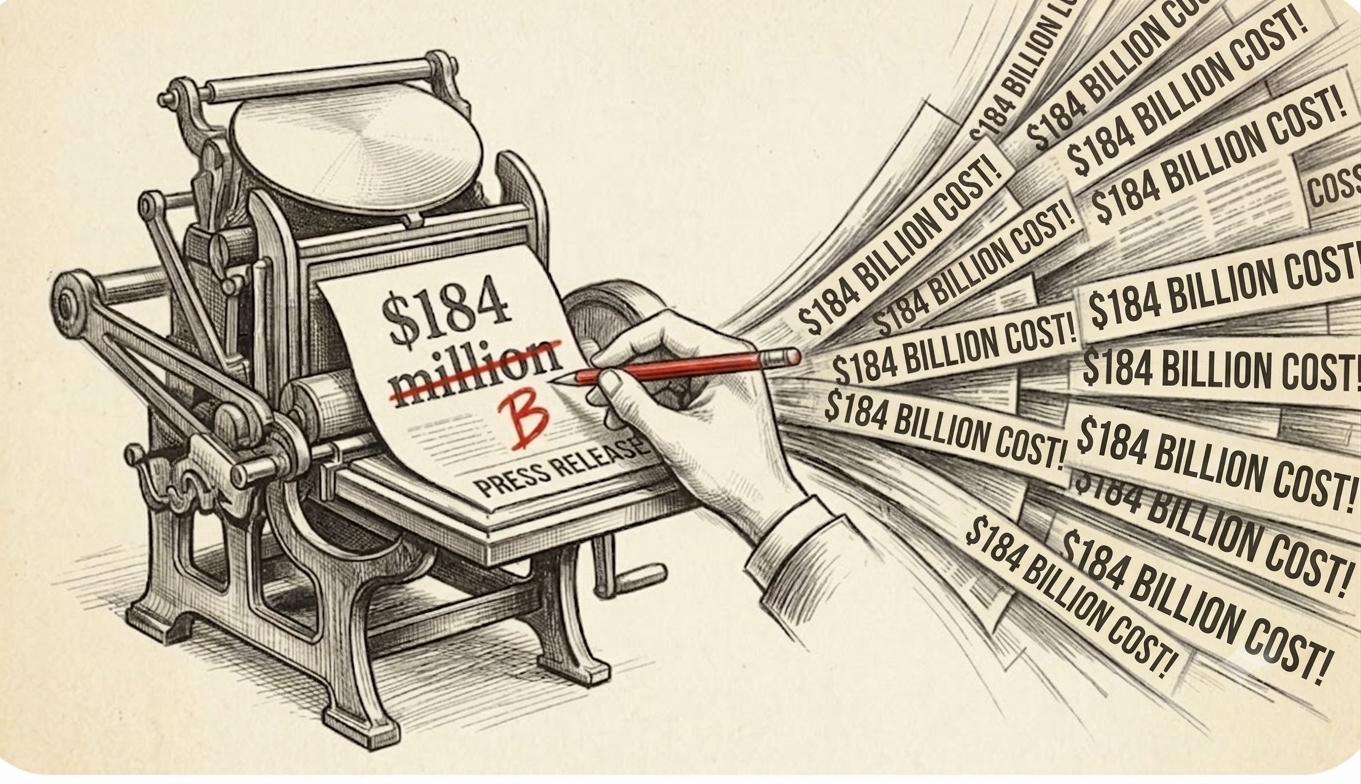
· Distortion 2. Soon after it appeared again in a press release – but by this stage the number had increased from $184 million to $184 billion, while the attribution stayed exactly the same.
· Distortion 3. The press release was then syndicated, almost word for word, across at least half a dozen business and finance publications, each one presenting it as news.
So here we have a real research finding that, within a few years, had become an unverifiable claim attributed to the wrong source, inflated a thousand times over, and laundered through enough outlets so that it now reads as an established fact.
Unfortunately, this example is not a one-off. The dodgier end of B2B content is plagued by what I’d call fake evidence: unattributed, unverifiable, and often completely misleading.
Humans caused the problem. AI is about to make it much worse.
This depressing experience tells us a lot about why trust in B2B content is declining. Of course, it would be easy to blame AI – easy, but wrong. Somewhere along the line, a writer didn't check a source. Someone else seems to have fat-fingered a unit from millions to billions. The newswire syndication machine disseminated the falsehood at scale. Up to this point, the error is all too human.
But AI is now amplifying the problem. Ask an LLM to find you a stat on supply chain risk, and it’s likely the number will crop up again, simply because it's one of the most widely repeated facts. The error is baked into the training data. And when content teams are tempted to turn to AI to source their facts, the dangers become ever more pronounced.
Trust: Years to earn, seconds to lose
Does it matter? A lot of companies seem quite happy to throw together a ragbag of secondhand data and pass it off as thought leadership. It’s a tactic I see everywhere, and let’s be honest: it can work if all you want is a nice bit of clickbait.
But if you are trying to build your brand as a provider of expertise and trusted insight, playing fast and loose with the evidence is a sure way to burn your company’s reputation. B2B buyers are less credulous than most. When they are weighing up who they are going to partner with on multi-million dollar projects, they are much more likely to scrutinize your claims.
It doesn't take much to tell the difference between two kinds of publisher. One sends a reader down a chain of secondhand citations, none of which leads anywhere authoritative. The other takes the time to do the work: original research, properly cited, traceable back to something real.
Evidence is the hallmark of quality
Reputable brands know what it means to use real evidence to support their arguments, and they are using robust evidence to differentiate against the proliferation of slop (whether that be AI or human in origin). Our own survey of 162 senior content and marketing leaders[1] found that competence with research and evidence is now seen as one of the most valuable capabilities a team can have, ranking above several skills that would once have seemed more obviously important.
That might sound unfashionable in a world obsessed with speed and efficiency, but B2B marketers themselves are increasingly recognising what their audiences already know. Truthful facts and convenient fakes do not look the same to a careful eye, and buyers are getting better at telling the difference between the two.
As fake evidence proliferates, B2B publishers need to apply a tougher sniff test to every fact they publish.
[1] A New Operating Model for Content: Study based on a survey of 162 marketing and thought leadership executives, Gareth Lofthouse and Satwant Pandher, 2026
